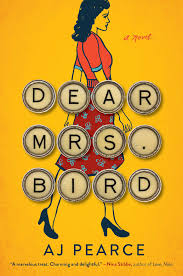
This is one of those books that lots of people have read but not many seem to have heard of – certainly far fewer than have read it, in my experience. That’s understandable – it’s definitely quiet in its quality, it doesn’t brag about being good. It is, however, very good and delightfully uplifting to read about women in a time when few of think of women enjoying many rights.
This book has been on my shelf for ages – as usual, I feel like I say this every time, but I buy them quicker than I can read them! Well, I say my shelf, I stole it off my mum so….
Anyway, I zipped through Dear Mrs Bird and I was charmed by every page. The length is perfect for the story, any longer and it would have dragged but there is enough in there to flesh it out. We follow Emmy – Emmeline, named presumably after the Emmeline Pankhurst as her grandmother was a staunch Suffragette – through her life in WII London. Living with her childhood best friend Bunty, she does her bit for the war effort but longs for a career in war journalism alongside her relationship with Edmund, her school sweetheart. Bunty, similarly enamored, strives to keep her head down and work where Emmy bends the rules.
Upon meeting the formidable Mrs Bird at her new job, Emmy begins to feel frustrated with her lot and Mrs Bird’s rules. People need help, real, useful advice, and no one is willing to give it. But Emmy just might be.
By about fifty pages in, you see where this is going. Except for the second major plot point – which I cannot name for spoiler-y reasons – which will smack you right in the gut. I suppose I should have seen it coming or at least something like it, but A.J. Pierce does such a good job of hiding what will happen. It crossed my mind that the first part of the book might be so obvious so as to obscure the second half.
What I like most about this book, I suppose, is its charm. Emmy and Bunty have a beautiful friendship, complimented by the exhausted Mr Collins and the nervous Kathleen. Much of their lives are magazines, writing, letters, rosy country cottages and a whiskey to calm the nerves. Slotted in among that are bombing raids, raging fires and death. It is eerie as well as charming.
It has occasionally been accused of seeing the war through rose-tinted glasses, but I must defend it here. As the novel is told through Emmy’s eyes, and her ‘just get on with it’ spirit was not uncommon, indeed it was the national policy on the war, domestically. What else could they have done?
Now, there have been criticisms of this book, some of which I see and agree with. Whilst it is very refreshing to see women’s roles in the forties not reduced to housework – they did actually take on a significant amount of war work – and accepting and liberal families like the Lakes did exist, they were likely not the norm and the novel is, in places, highly flippant about the lack of equality that women faced. Or perhaps, I should say, Emmy is flippant. The novel is through her eyes and so perhaps I might be wrong – why should she hold the exact same view as me, eighty years later, when she’s right in the middle of it? Either way, the novel is enjoyable and accurate but does not tell a typical story.
The ending is a definite deus ex machina. I have no real problem with these, it’s a real feel good moment when someone shows up to save the day, but I was left with the feeling of ‘well, this all tied together nicely’ or ‘Rather Nicely’ as Emmy might put it. I did like this book, but it is a quick, refreshing read without huge amounts of other layers.
I’d definitely give it a read, even if you are into longer, more serious fiction or even war non-fiction. It might surprise you!
 Read With Me